Why can one highly rated anime feel instantly absorbing while another feels like work? The difference is often not quality. It is the combination of genre, tone, pacing, themes, and the kind of payoff the story promises.
Anime labels can be confusing because they do not all describe the same thing. Shonen, shojo, seinen, and josei usually refer to publishing demographics. Terms such as romance, horror, sports, and fantasy describe story content. Labels such as slice of life and isekai describe a structure, setting, or storytelling approach.
Understanding those differences makes it easier to search for shows that suit your taste instead of relying on popularity lists alone.
First, Separate Demographics from Genres
Four frequently used anime labels originated as demographic categories in Japanese manga publishing. An anime adapted from a manga may retain the demographic label of the publication in which the manga appeared.
- Shonen (shōnen): associated primarily with a teenage male readership.
- Shojo (shōjo): associated primarily with a teenage female readership.
- Seinen: associated primarily with an adult male readership.
- Josei: associated primarily with an adult female readership.
These categories are useful clues, but they do not define who is allowed to enjoy a series. They also do not guarantee a specific plot, tone, or maturity level.
For example, a shonen title might be an action adventure, romantic comedy, mystery, or sports drama. Haikyu!! is commonly identified as shonen, but its central appeal comes from volleyball, teamwork, rivalry, and gradual skill development rather than fantasy combat. Likewise, seinen does not automatically mean violent or sexually explicit; it can include quiet comedy, historical drama, science fiction, or everyday life.
Useful rule: treat a demographic label as background information, then look for separate labels describing the actual story.
What the Most Common Anime Genres Usually Offer
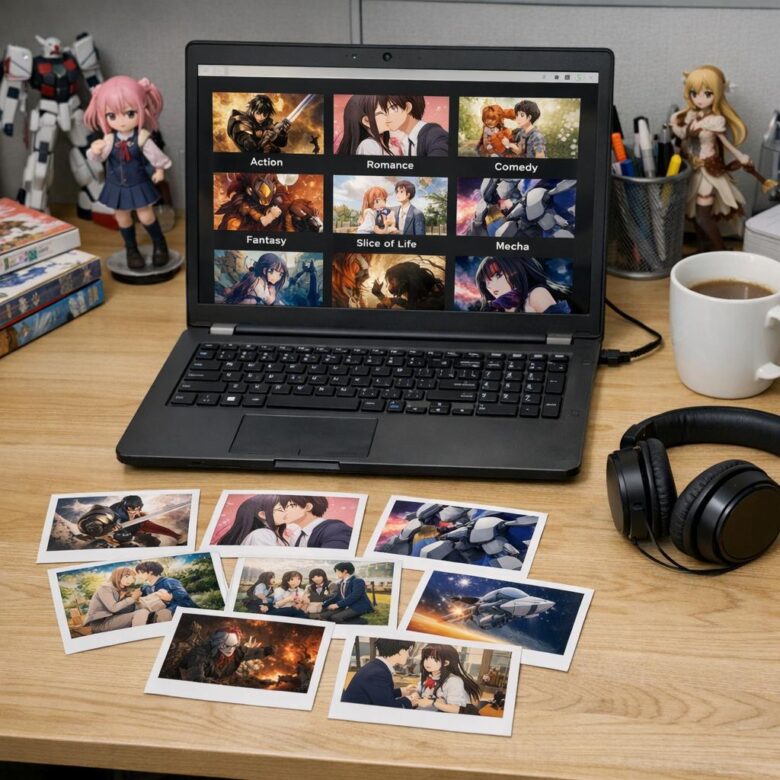
Most anime combine several genres. The descriptions below explain the experience each label generally suggests, not a rigid set of requirements.
Action and Adventure
Action anime emphasizes conflict, movement, competition, battles, or dangerous situations. Adventure adds a journey, mission, changing locations, or a larger goal.
Choose these when you want: momentum, visible progress, major confrontations, escalating challenges, or cliffhangers.
Check before watching: how much of the series is devoted to fighting, training, travel, comedy, or character development. Two action shows can have very different pacing and levels of violence.
Romance
Romance focuses on attraction, relationships, emotional uncertainty, and the barriers separating characters. Some series build toward a relationship, while others begin with an established couple and explore what follows.
Choose romance when you want: emotional anticipation, relationship development, character chemistry, or interpersonal drama.
Important distinction: a “romantic subplot” may receive much less attention than a series categorized primarily as romance. Also consider whether you prefer comedy, serious drama, a love triangle, or a more direct relationship.
Comedy
Anime comedy can include wordplay, parody, misunderstandings, exaggerated reactions, absurd situations, or jokes based on familiar genre conventions.
Choose comedy when you want: a lighter watch, short story arcs, playful characters, or relief between heavier series.
Humor is especially dependent on personal taste. A comedy built around slapstick may not appeal to someone who prefers dry dialogue or character-based humor, even though both carry the same genre label.
Drama
Drama emphasizes emotional conflict, difficult choices, changing relationships, grief, ambition, family tension, or personal growth. It often overlaps with romance, sports, historical fiction, and slice of life.
Choose drama when you want: emotional investment, consequences, serious character development, or a story designed to linger after an episode ends.
A drama label alone does not indicate how intense the material will be. Read a spoiler-light synopsis and check content information if particular subjects are a concern.
Fantasy and Supernatural
Fantasy uses invented worlds, magic, mythical beings, or rules that do not exist in ordinary life. Supernatural stories bring unusual forces—such as spirits, curses, or psychic abilities—into an otherwise recognizable setting.
Choose these when you want: imaginative settings, magical systems, folklore, unusual powers, or conflicts beyond everyday reality.
Some fantasy anime spend considerable time explaining their worlds. Others treat magic as background and concentrate on relationships or adventure. Look at the synopsis to determine which approach a series takes.
Science Fiction and Mecha
Science fiction explores technology, space travel, artificial intelligence, altered societies, scientific speculation, or possible futures. Mecha centers on piloted or otherwise controlled machines, often but not always in military conflicts.
Choose these when you want: technological ideas, large-scale conflict, political tension, tactical battles, or questions about humanity and society.
Mecha is not simply “robots fighting.” Some titles emphasize spectacle, while others focus more heavily on pilots, war, institutions, or the consequences of using powerful machines.
Mystery, Thriller, and Psychological Anime
Mystery is built around unanswered questions and the process of uncovering information. Thrillers emphasize danger, suspense, pursuit, or high-stakes decisions. “Psychological” usually signals attention to mental conflict, perception, manipulation, or unstable circumstances.
Choose these when you want: theories, twists, strategic conflict, unreliable information, or episodes that reward close attention.
These labels often appear together but are not interchangeable. A slow detective mystery may have little immediate danger, while a thriller can be tense without asking the audience to solve a central puzzle.
Horror
Horror aims to create fear, dread, shock, or discomfort. It may use monsters, body horror, psychological pressure, isolation, gore, or supernatural threats.
Choose horror when you want: unsettling atmosphere, survival tension, frightening concepts, or disturbing imagery.
Genre labels are not adequate content warnings. If violence, self-harm, sexual material, flashing imagery, or another sensitive subject matters to you, consult the title’s official rating information and detailed content guidance before watching.
Sports
Sports anime follows athletes, teams, training, competition, and improvement. The sport supplies the structure, but the emotional appeal often comes from rivalry, teamwork, setbacks, and pressure.
Choose sports anime when you want: clear goals, measurable progress, ensemble casts, tournament arcs, or motivational character development.
You do not necessarily need prior knowledge of the sport. Many series explain essential rules through new players or early matches, although the amount of technical detail varies.
Slice of Life
Slice of life focuses on routines, relationships, school, work, family, hobbies, or other everyday experiences. Some series are almost entirely episodic; others use ordinary moments to build a larger emotional story.
Choose slice of life when you want: character interaction, a grounded setting, small-scale conflicts, or a break from plot-heavy viewing.
Slice of life does not always mean cheerful or relaxing. March Comes in Like a Lion, for example, uses quiet daily scenes while addressing isolation, family pressure, depression, and professional competition.
Isekai
Isekai means “another world.” These stories usually transport, summon, trap, or reincarnate a character into a world different from their original one.
The setup can support many kinds of stories, including adventure, comedy, romance, political drama, or dark fantasy. Game-like statistics and skill systems are common in some isekai, but they are not required.
Choose isekai when you want: world discovery, a protagonist learning unfamiliar rules, fantasy progression, or a contrast between two ways of life.
Pay attention to the secondary genre. “Isekai” explains the premise, but “comedy isekai” and “dark fantasy isekai” can produce completely different viewing experiences.
Iyashikei
Iyashikei is associated with soothing, restorative stories. These anime often feature gentle routines, pleasant environments, supportive relationships, and low-intensity conflict.
Choose iyashikei when you want: calm pacing, atmosphere, warmth, or minimal suspense.
Viewers looking for a strong central conflict or rapid plot development may find this style too uneventful. That is a taste mismatch rather than a flaw.
Tone and Pacing Matter as Much as Genre
Genre tells you what kind of material is present. Tone and pacing tell you how that material feels.
A fantasy series might be playful, tragic, frightening, romantic, or politically complex. A school setting might support a cheerful comedy, an intense competition story, or a serious drama. This is why searching for “fantasy anime” alone can produce inconsistent recommendations.
Use three layers when describing what you want:
- Core content: romance, mystery, sports, fantasy, science fiction, or another broad genre.
- Preferred tone: comforting, funny, suspenseful, dark, hopeful, bittersweet, or intense.
- Preferred pace: episodic, slow-building, steadily progressing, or fast and cliffhanger-driven.
A specific preference such as “a hopeful, steadily paced sports drama” is more useful than “a good shonen.” Similarly, “a slow supernatural mystery with little comedy” narrows the field more effectively than “something dark.”
A Practical Method for Finding Anime That Fits
1. Identify the payoff you want
Ask what should make the viewing time feel rewarding:
- Excitement: action, adventure, sports, thriller, or battle-focused fantasy.
- Emotional connection: drama, romance, coming-of-age, or character-focused slice of life.
- Relaxation: iyashikei, gentle comedy, or low-conflict slice of life.
- Curiosity: mystery, psychological drama, science fiction, or supernatural suspense.
- World exploration: fantasy, isekai, historical fiction, or space adventure.
- Laughter: parody, romantic comedy, absurd comedy, or ensemble comedy.
2. Choose your tolerance for tension
Consider how much danger, conflict, embarrassment, or sadness you want at the moment. “Romance” can range from a light comedy to a painful relationship drama. “Fantasy” can range from a gentle journey to graphic dark fantasy.
If you want a low-stress series, do not rely on colorful artwork or a school setting as proof that the content is light. Check the synopsis, rating, and content information.
3. Decide how much attention you want to give
- For casual or interrupted viewing: episodic comedy and straightforward slice of life may be easier to resume.
- For focused viewing: mysteries, political stories, and complex science fiction often reward attention to details and names.
- For binge-style momentum: thrillers, tournaments, adventures, and serialized dramas often use continuing conflicts and cliffhangers.
These are tendencies rather than guarantees. Check whether a particular show is episodic or serialized instead of assuming from genre alone.
4. Check the commitment
Before starting, verify the number of episodes, season structure, related films, and whether earlier entries are required. Use the anime’s official website, publisher information, or the official listing on the service available in your region. Episode counts, licensing, and streaming availability can change.
You do not need to commit to an entire franchise immediately. Begin with the main entry in the recommended viewing order and decide whether the characters and storytelling style work for you.
5. Sample with a specific question
Watching one to three episodes can reveal the basic tone, humor, visual presentation, and character dynamics. Instead of asking only “Is this good?”, ask:
- Do the characters make me curious about what happens next?
- Do I enjoy the balance between dialogue, action, and comedy?
- Is the pace satisfying or frustrating?
- Does the central conflict interest me?
- Am I comfortable with the show’s content and tone?
Some stories develop slowly, so an early sample cannot reveal everything. However, popularity or promises that a show “gets good later” do not obligate you to continue something you are not enjoying.
Use a Taste Profile Instead of a Single Favorite
A favorite anime can be misleading if you do not know which part you liked. Break it into components.
For example, someone who enjoys Death Note might be responding to:
- the contest of strategy;
- the supernatural premise;
- the morally compromised protagonist;
- the suspense and reversals;
- or the conflict between investigators and suspects.
Those preferences could lead to very different recommendations. Searching only for “anime like Death Note” may produce titles that share surface details but not the feature that mattered most.
Create a short taste profile using this formula:
I want a [genre] series with a [tone], [pace], and emphasis on [favorite story element]. I would prefer to avoid [unwanted element].
A hypothetical example would be: “I want a fantasy series with a hopeful tone, steady pacing, and an emphasis on exploration rather than romance.” This gives recommendation tools and other viewers much clearer criteria.
Common Mistakes When Using Anime Genre Labels
Assuming demographic labels predict maturity
Shonen does not mean suitable for every child, and seinen does not automatically mean explicit. Verify the rating and content details for the specific title. Rating systems can also differ by country and platform.
Treating every show in a genre as similar
Two romance anime may differ in setting, humor, relationship progress, and emotional intensity. Two mecha series may share machines but disagree completely in tone and purpose. Use secondary genres and a spoiler-light synopsis to refine your choice.
Choosing by popularity alone
Popularity indicates broad attention, not personal compatibility. A celebrated slow drama will still feel slow to someone seeking immediate action. Use rankings to discover options, then evaluate those options against your own criteria.
Confusing setting with genre
“School anime” describes a setting, not one unified experience. A school story can be horror, romance, sports, mystery, comedy, or science fiction. The same applies to historical, workplace, and military settings.
Assuming animation style reveals the tone
Bright designs can accompany serious themes, while realistic artwork can appear in comedy. Promotional images provide limited information. Read the official synopsis and check appropriate content guidance when tone matters.
Rejecting an entire genre after one mismatch
The problem may have been the pacing, humor, protagonist, level of fan service, or story structure rather than the broad genre. Compare two titles with the same main genre but different tones before deciding that the category itself does not appeal to you.
Quick Genre-Matching Checklist
Before adding a show to your watchlist, answer these questions:
- What are its main and secondary genres?
- Is its tone comforting, comedic, suspenseful, dark, or mixed?
- Is the story episodic or heavily serialized?
- Does it emphasize plot, characters, atmosphere, romance, or action?
- How long is the available story, and are related entries required?
- Does the age rating fit the intended audience?
- Are there content elements you want to avoid?
- Is it officially available in your region?
For details that may change—particularly regional availability, episode listings, ratings, and viewing order—check the title’s official website or its official page on the relevant distributor or streaming service.
Final Takeaway
The most useful anime label is rarely a single word. A better match comes from combining genre, tone, pacing, story emphasis, and viewing commitment.
Start with the experience you want, add one or two genres, and identify anything you would rather avoid. Then sample the series and judge the elements that matter to you—not whether it appears on a must-watch list.
Genres are navigation tools, not promises. Once you learn which combinations hold your attention, finding your next anime becomes much easier.

The Enfet Otaku Life Editorial Team creates and maintains practical guides about anime viewing, conventions, cosplay, collectibles, merchandise, and licensed streaming. The site focuses on clear, useful information and encourages readers to verify time-sensitive details with official sources.