A good anime collection storage system has two jobs: protect each item from avoidable damage and make the collection easy to use or enjoy. The challenge is that manga, figures, posters, plushies, acrylic stands, and boxed merchandise have different support, light, dust, and moisture needs.
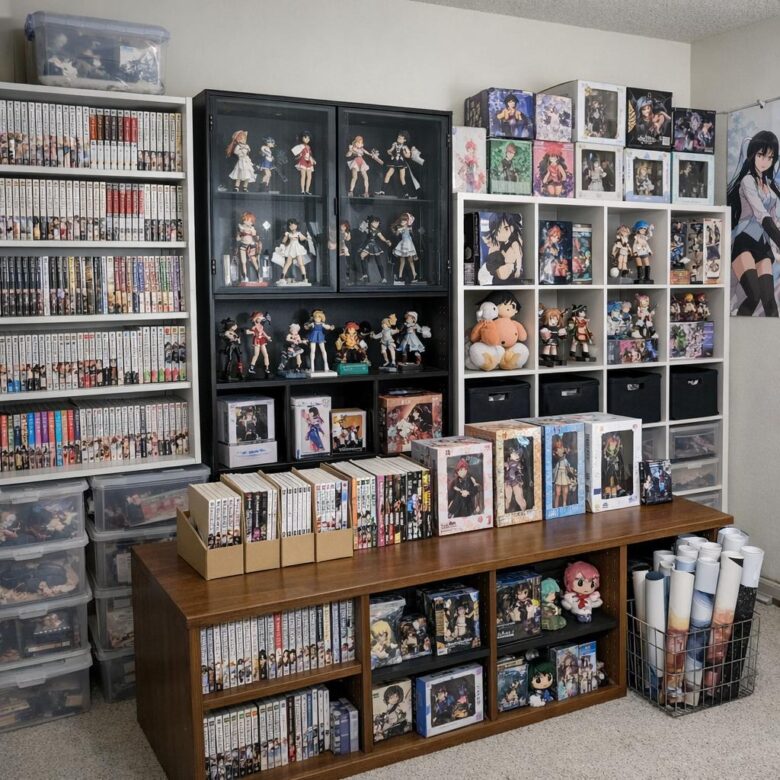
Instead of forcing everything onto one shelf, divide the collection by material and display priority. Keep frequently viewed favorites accessible, place fragile pieces in protected displays, and use labeled storage for items that do not need to remain visible.
Choose Storage by Item Type
| Collection type | Practical storage choice | Main risks to avoid |
|---|---|---|
| Manga and art books | Adjustable bookcase with bookends | Leaning, overcrowding, damp walls, and direct sunlight |
| Figures and statues | Enclosed cabinet or individual display case | Dust, sunlight, heat, falls, and pressure on delicate parts |
| Posters and prints | Protective frame, portfolio, or archival-quality tube | Creases, adhesives, fading, crushed edges, and moisture |
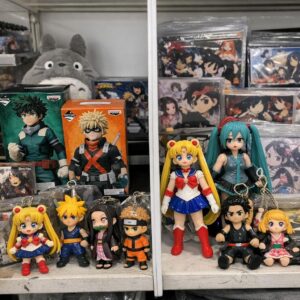
| Acrylic stands and keychains | Compartment organizer, display riser, or divided drawer | Surface scratches, lost parts, and crowded displays |
| Plushies and fabric merch | Clean shelf, breathable container, or closed cabinet | Dampness, pests, dust, stains, and compression |
| Boxed or seasonal merchandise | Labeled lidded bins on sturdy shelving | Crushing, unstable stacks, trapped moisture, and forgotten contents |
Best Ways to Store Manga and Art Books
Manga should stand upright on a level shelf, supported by neighboring volumes or a bookend. Books that lean for long periods can develop distorted covers or spines. Do not pack a row so tightly that removing one volume requires pulling on the top of its spine.
- Match shelf spacing to the books. Adjustable shelves reduce wasted vertical space and make room for oversized editions and art books.
- Put heavy items low. Box sets, hardcovers, and large-format books belong on lower shelves to improve furniture stability.
- Keep books away from problem areas. Avoid direct sunlight, radiators, heating vents, leaking windows, and damp exterior or basement walls.
- Support incomplete rows. Use a stable bookend instead of letting a few volumes lean across an empty shelf.
- Store oversized books flat when necessary. A short, stable stack can be safer than standing a large book that cannot support its own weight. Avoid tall stacks that make lower books difficult to retrieve.
Double-row shelving can increase capacity, but it makes the back row difficult to see and reach. If space requires two rows, place the rear row on a sturdy riser and keep enough clearance to remove books without scraping them against the shelf above.
Plastic sleeves are optional rather than essential for ordinary manga. For collectible editions, choose materials specifically identified by the manufacturer as suitable for long-term paper or photographic storage. Check the actual material and care information rather than relying only on broad terms such as “archival.”
Furniture safety matters
Books are heavy when grouped together. Check the shelf unit’s stated load limits and assembly instructions before filling it. Anchor tall furniture according to the manufacturer’s directions, especially in homes with children, pets, or earthquake risk. Do not use a visibly bowed shelf for additional box sets.
Figure Storage: Visibility Without Crowding
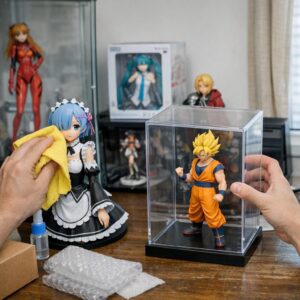
Figures need stable footing, enough clearance for projecting parts, and protection from falls. Enclosed glass or acrylic cabinets reduce routine dust exposure, while individual cases can work for a small number of figures. Open shelves remain usable if they are positioned away from busy walkways and cleaned carefully.
Measure before buying a cabinet
Use the figure’s assembled dimensions, not only the box dimensions. Include the base, raised weapons, hair, wings, effect parts, and any planned riser. Leave extra clearance around delicate projections so the figure does not touch a door, wall, shelf above, or neighboring piece.
- Place tall or top-heavy figures on a stable surface where the base sits completely flat.
- Do not force a figure into a shelf by bending a weapon, support rod, or removable part.
- Avoid placing heavy figures on thin shelves unless the cabinet specifications support the load.
- Use manufacturer-provided support stands when included.
- Keep packaging and assembly instructions if they will be needed for moving or storing the figure later.
Direct sunlight can fade paint and raise the temperature inside a display. UV-filtering film or glazing may reduce exposure, but it does not make a sunlit location risk-free. Distance from the window, curtains, and room layout remain important.
Store accessories separately
Alternate faces, hands, weapons, pegs, and adapters are easy to lose. Put each figure’s small parts in its own labeled bag or compartment, then place those bags in a divided organizer. Avoid allowing painted pieces to rub against one another. Keep tiny accessories away from children and pets.
If a figure will remain boxed, do not place heavy cartons on top of it. Store boxes on shelving rather than directly on a floor where leaks or cleaning water could reach them.
Poster and Art Print Storage
The right method depends on whether the poster will be displayed, rotated, or stored for a long period.
For displayed posters
Use a correctly sized frame that supports the print without tape, putty, pins, or adhesive touching the artwork. A mat or spacer can prevent the printed surface from resting directly against the glazing. Verify that any backing, mat, or sleeve is intended for long-term paper storage.
UV-filtering glazing can slow light-related damage, but no frame completely prevents fading. Keep important prints out of direct sunlight and away from strong, continuous light when possible.
For posters that are rotated
A large portfolio with protective pages keeps prints flat and makes them easier to browse. Confirm that the portfolio is large enough to hold the artwork without bending its edges. Insert and remove posters with clean, dry hands, supporting the sheet rather than pulling from one corner.
When flat storage is not possible
Use a wide, sturdy tube made for document storage. Roll the poster loosely around a clean core rather than creating a tight roll, and do not secure it with rubber bands. Before choosing a tube or interleaving paper for a valuable print, verify the material specifications and long-term storage guidance from the manufacturer.
Avoid repeatedly switching a print between tight rolling and flattening. Frequent handling increases the chance of edge damage, surface marks, and creases.
Acrylic Stands, Pins, Keychains, and Small Merch
Small merchandise creates clutter because each item is easy to place somewhere temporarily. A divided system makes pieces visible without allowing metal clasps, chains, or acrylic surfaces to scrape one another.
- Acrylic stands: Display them on tiered risers or store each one in a soft sleeve or separate compartment. Keep the base with the matching character piece.
- Keychains and charms: Hang them on a dedicated grid or store them in labeled compartments so chains do not tangle.
- Pins and badges: Use a pin board for display or individual pockets for storage. Do not leave sharp posts loose in a drawer.
- Trading cards and postcards: Use appropriately sized pages, sleeves, or boxes made for paper collectibles. Avoid overfilling pockets.
Some acrylic merchandise arrives with a removable protective film. Check the item’s packaging or seller instructions before trying to peel anything away; not every cloudy or textured surface is removable film. Clean acrylic with a soft, non-abrasive cloth and follow the maker’s care guidance.
Plushies and Fabric Merchandise
Plushies need protection from dust and moisture without being crushed into an overfilled container. Open shelving provides easy access but requires more cleaning. A closed cabinet offers better dust control, while a breathable fabric container may suit items kept out of sight in a dry room.
- Make sure fabric items are completely dry before storage.
- Do not compress structured plushies if doing so could distort faces, embroidery, or internal supports.
- Keep food and drinks away from plush displays.
- Inspect stored fabric periodically for dampness, odors, stains, or pest activity.
- Follow the sewn-in care label before washing or spot-cleaning an item.
Vacuum bags save space but are not ideal for every plush. Long-term compression can alter the shape of stuffing or damage attached decorations. Reserve compression for items whose materials and construction can tolerate it.
Bins for Boxed, Seasonal, and Overflow Merchandise
Lidded bins are useful for convention purchases, duplicate packaging, seasonal displays, and merchandise that does not need permanent shelf space. Clear bins make contents visible; opaque bins reduce light exposure. Either option works better when the contents are cataloged.
Do not seal damp items in a bin. A tightly closed container can trap existing moisture rather than solve a humidity problem. Moisture-control packets also require monitoring and replacement according to their instructions; they are not a substitute for fixing a damp room or leak.
Use labels that remain useful after stacking
Label at least one short side and one long side so the bin can be identified from different shelf positions. Use specific categories such as “acrylic stands—Series A” or “figure accessories—shelf 2,” rather than a broad label such as “anime stuff.”
Store heavier bins at the bottom and avoid stacks that must be dismantled whenever one item is needed. Keep all bins off floors that are vulnerable to leaks or flooding.
Control Light, Dust, Heat, and Moisture
Most collections do not need a museum-style room, but they benefit from a stable indoor environment. Rapid changes, persistent dampness, strong sunlight, and nearby heat sources are more concerning than minor day-to-day variation.
- Light: Move paper and painted items away from direct sun. Rotate displays if one side receives more light.
- Dust: Use cabinet doors where practical and clean shelves before returning items.
- Heat: Avoid radiators, heaters, hot electronics, and enclosed areas that become noticeably warm.
- Moisture: Address leaks, condensation, or musty rooms before adding sealed storage.
- Airflow: Do not press bookcases tightly against a wall with a known condensation problem.
A basic hygrometer can help identify unusual room conditions, but readings should be interpreted alongside signs such as condensation, musty odors, warped paper, or recurring mold. If the room has persistent moisture problems, resolve the building or ventilation issue rather than relying only on packets inside containers.
Storage Ideas for Small Rooms
When floor space is limited, prioritize vertical organization without creating unsafe, overloaded furniture.
- Add manufacturer-compatible shelves to an adjustable bookcase where load limits allow.
- Use shelf risers to create a visible second figure row without balancing figures on boxes.
- Place lightweight plushies on higher shelves and heavy books lower down.
- Use shallow drawer organizers for pins, stands, keychains, and figure accessories.
- Rotate displays instead of trying to show the entire collection at once.
- Keep a small amount of empty space for future volumes or figures.
Wall shelves can free floor space, but their safety depends on the wall material, fixings, installation, and load. Follow the shelf and hardware manufacturers’ instructions and use appropriate professional help when the installation is uncertain.
Create a Simple Collection Inventory
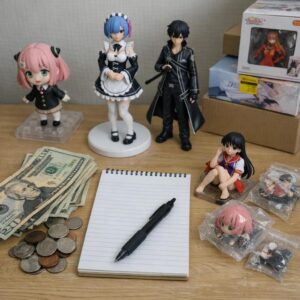
An inventory prevents forgotten purchases and makes stored items easier to locate. It does not need to be complicated. A spreadsheet or note can record:
- Series or franchise
- Item type and character
- Edition or identifying details
- Condition and missing parts
- Storage location
- Whether the original box and accessories are present
Photographing the item and its accessories before storage can also help with reassembly and identification. For insurance questions, ask the insurer what documentation it accepts rather than assuming a personal spreadsheet will be sufficient.
Common Storage Mistakes
- Buying furniture before measuring: Check the room, doorway, shelf depth, item height, and required clearance first.
- Overloading shelves: Manga and art books become heavy quickly. Respect stated load limits.
- Displaying everything in sunlight: A bright location may look attractive while increasing fading and heat exposure.
- Using tape or putty on posters: Adhesives can stain, tear, or distort paper.
- Stacking figure boxes too high: Lower boxes can crush, and unstable stacks can fall.
- Storing items directly on the floor: This increases exposure to leaks, dirt, impact, and pests.
- Sealing items while damp: Closed storage traps existing moisture.
- Throwing accessories into one container: Small parts become scratched, mixed up, or lost.
- Assuming “archival” guarantees safety: Review the stated materials, intended use, and manufacturer guidance.
A Practical Setup Plan
- Sort the collection into manga, figures, paper goods, fabric merchandise, small accessories, and boxed overflow.
- Choose display priorities. Decide which items should remain visible and which can be rotated.
- Measure everything. Record available wall space, shelf depth, figure height, and poster dimensions.
- Check the room. Identify direct sunlight, heat sources, damp areas, pet access, and busy walkways.
- Select storage by risk. Use stronger dust and light protection for fragile or difficult-to-replace pieces.
- Label hidden storage. Record the exact bin, drawer, or shelf location.
- Review the setup periodically. Look for leaning books, shelf bowing, loose figure supports, condensation, dust buildup, or overcrowding.
The best anime merch storage is not necessarily the largest or most expensive setup. It is a stable, maintainable system that gives each material appropriate support, keeps vulnerable items away from light and moisture, and lets you find and enjoy the collection without moving unsafe stacks.

The Enfet Otaku Life Editorial Team creates and maintains practical guides about anime viewing, conventions, cosplay, collectibles, merchandise, and licensed streaming. The site focuses on clear, useful information and encourages readers to verify time-sensitive details with official sources.